
Many new fans ask one simple question when they start watching soccer: how long are the soccer games? The answer sounds easy at first, but match duration can change a lot depending on age group, competition rules, and what happens during the game. Knowing how time works in soccer helps us enjoy the sport more, argue less about the clock, and follow every minute with confidence.
How Long Are The Soccer Games In Professional Leagues?
When most people ask how long are the soccer games, they are thinking about top level matches such as the World Cup, the English Premier League, Major League Soccer, or the UEFA Champions League. In these competitions, the basic structure is almost always the same.
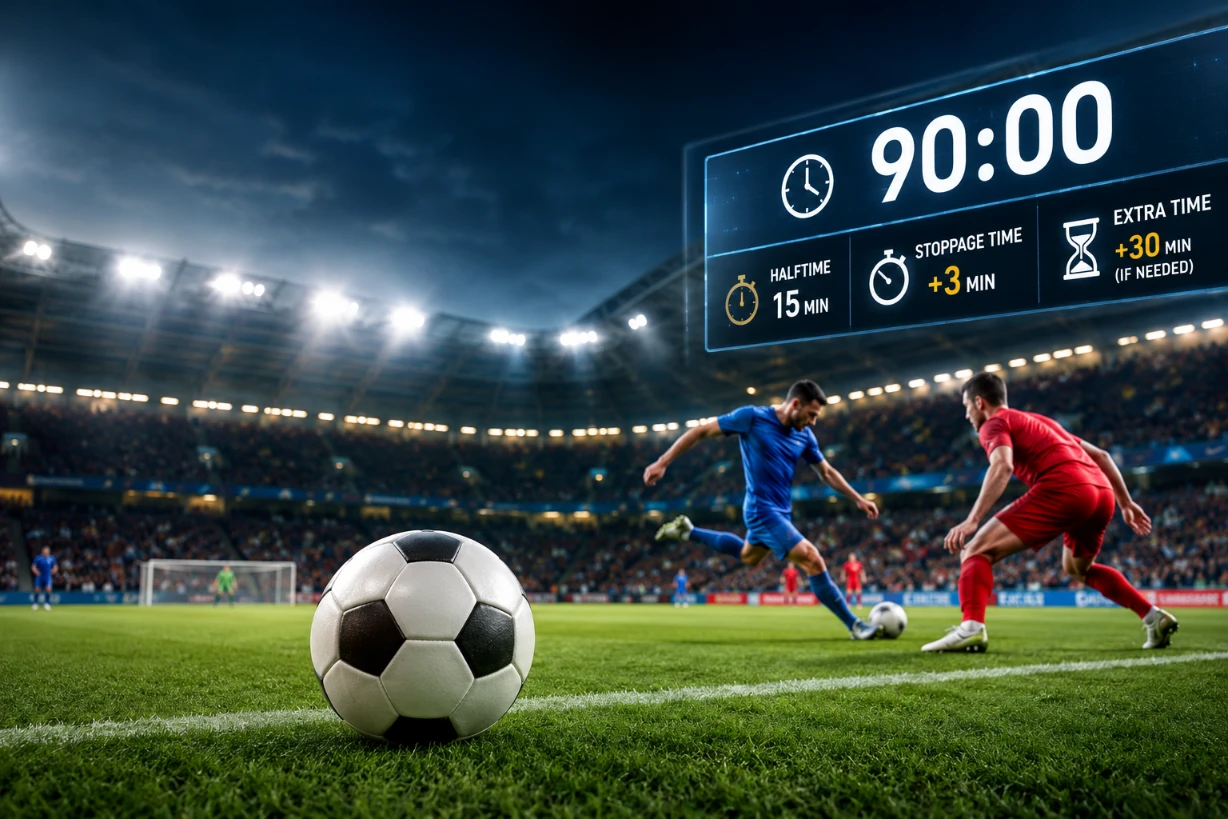
A standard professional match is played in two halves of 45 minutes each. That gives 90 minutes of regular time. There is a 15 minute halftime break between the first and second half. So, on paper, a match has 105 minutes from kickoff to the start of the second half and then 90 minutes of playing time.
However, anyone who has watched live soccer knows a match almost never finishes exactly at 90 minutes. Referees add extra time, often called stoppage time, at the end of each half to make up for delays such as injuries, substitutions, and time wasting. This means the real answer to how long are the soccer games in pro soccer is usually closer to 95 to 100 minutes from first whistle to final whistle, and sometimes even longer.
Why Do Soccer Matches Have Stoppage Time?
Unlike sports such as basketball or American football, the clock in soccer does not stop every time play is interrupted. The referee keeps track of lost time on a separate watch. At the end of each half, the referee adds what is known as stoppage time or added time.
Some common reasons for added time include:
- Injuries that require treatment on the field
- Player substitutions, which usually slow down the game
- Goal celebrations that take longer than normal
- Time wasting tactics, such as slow throw ins or free kicks
- VAR (Video Assistant Referee) checks in competitions that use video review
During big tournaments, it is normal to see 3 to 7 minutes of stoppage time added, sometimes more if there were long breaks. So when we ask how long are the soccer games, we have to remember that the official 90 minutes is only the base. The real match length depends on the flow of the game and the decisions of the referee.
How Long Are Soccer Games With Extra Time And Penalties?
In league play, many games can end in a draw after 90 minutes plus stoppage time. But in knockout competitions such as the World Cup, Champions League, or national cup tournaments, a winner is needed. In these cases we must look deeper at how long are the soccer games, because the match can go far beyond 90 minutes.
If the score is tied after regular time, many competitions use extra time. Extra time is usually made up of two halves of 15 minutes each, with a short break in between. That adds 30 minutes to the match. The referee can also add stoppage time at the end of each extra time period.
If the score is still tied after extra time, then the game often goes to a penalty shootout. A full match with extra time and penalties can easily last more than 120 minutes from the first whistle until the final kick. Fans who want to know how long are the soccer games in these high pressure situations should be ready to watch for around two and a half hours including all breaks, celebrations, and post match reactions.
How Long Is A Youth Soccer Game?
How long are the soccer games for kids and teenagers? Here, the answer changes with age, because younger players cannot safely play full length matches like adults. Soccer groups and federations across the world use age brackets and shorter halves to match a child’s physical growth and attention span.
Exact rules vary between countries and leagues, but the pattern is similar. Younger ages play shorter games with smaller fields and fewer players, then move closer to adult rules as they grow. Parents and coaches should always check their local league rulebook, but the idea stays the same everywhere.
Common Youth Match Lengths By Age
The table below gives a general idea of how long are the soccer games for common youth age groups. Local rules might not be exactly the same, but this guide helps set expectations.
| Age Group | Typical Half Length | Total Regular Time |
|---|---|---|
| Under 6 | 8 to 10 minutes | 16 to 20 minutes |
| Under 8 | 20 minutes | 40 minutes |
| Under 10 | 25 minutes | 50 minutes |
| Under 12 | 30 minutes | 60 minutes |
| Under 14 | 35 minutes | 70 minutes |
| Under 16 | 40 minutes | 80 minutes |
| Under 18 | 45 minutes | 90 minutes |
These values help answer how long are the soccer games for young players at different stages, but we should remember that local clubs may adjust them slightly for safety, weather, or tournament setups.
How Long Do High School And College Soccer Games Last?
In the United States, many players first experience organized soccer through school teams. So it is natural for families to ask how long are the soccer games at the high school or college level.
High School Soccer
High school soccer in most states follows rules that are close to the adult game. Games are usually played in two 40 minute halves, giving a total of 80 minutes of regular time. Halftime is often 10 minutes, but can change based on state rules or event schedules.
If the match is tied and a winner is needed, such as in playoffs, some states use extra time followed by penalty kicks. Others may go directly to penalties. Because rules can vary, players and parents should check with coaches to understand how long are the soccer games in their specific league.
College Soccer
College soccer, especially in the NCAA, typically uses two 45 minute halves, aligning with FIFA adult rules for a total of 90 minutes. There is usually a 15 minute halftime break.
In past years, college soccer often used golden goal overtime, where the first team to score in extra time won the match. Recent rule changes have moved college soccer closer to international standards, reducing extra time in regular season play. But knockout tournaments may still use extra time and penalties. So again, how long are the soccer games in college can depend on whether it is a season game or a playoff match.
How Long Does A Soccer Game Take In Real Time?
Fans who attend live matches or watch on TV usually care less about exact playing minutes and more about how long the whole event will last. When we ask how long are the soccer games in real clock time, we have to include warmups, pregame rituals, halftime, and post match delays.
For a typical professional or top level game, this is a reasonable estimate:
- Warmups and pregame ceremonies: 20 to 30 minutes before kickoff
- First half: 45 minutes plus 2 to 5 minutes stoppage
- Halftime: about 15 minutes
- Second half: 45 minutes plus 3 to 7 minutes stoppage
Altogether, the full experience often lasts close to two hours from the scheduled kickoff time, and around two and a half hours from when fans first get into their seats. If extra time and penalties are needed, the total can stretch to nearly three hours.
Why Does Soccer Use A Running Clock?
New fans from American sports sometimes feel puzzled that the clock in soccer keeps going even when the ball is out of play. When they ask how long are the soccer games, part of their wonder is about why the sport uses this timing style at all.
The running clock has deep roots in soccer history and culture. It helps the game flow more smoothly, keeps breaks shorter, and makes time feel like a shared pressure for both teams. The referee’s control over stoppage time also allows some room for judgment, which can feel unfair when we cheer for one side, but often keeps matches moving at a good pace.
In recent years, some tournaments and leagues have tried to be more open about how they calculate added time, especially with the use of VAR. Still, the basic method remains. When we ask how long are the soccer games today, we are really asking how time, flow, and fairness come together in one simple but powerful system.
How Tournament Formats Affect Match Duration
Not every competition uses the same format, and this can change how long are the soccer games in that event. Several factors matter:
First, group stage matches in cups and international tournaments can end in draws without extra time. These games usually last around 95 to 100 minutes of real playing time, similar to league matches. Second, knockout rounds often require a winner and may use extra time followed by penalty kicks. That can add 30 minutes of play plus more stoppage time.
Some youth or amateur tournaments use shorter halves to allow teams to play more games in a single day. Others skip extra time and go straight to penalty shootouts to keep schedules on track. When we think about how long are the soccer games at a weekend tournament, the answer may be very different from a normal league game.
Match Duration In Futsal, Indoor, And Small Sided Soccer
How long are the soccer games when they are played indoors, on futsal courts, or on small fields? Here, the clock and rules can change completely, even though the spirit of the game remains the same.
Futsal
Futsal is a fast indoor version of soccer, often played on a hard court with 5 players per team. Official futsal matches use two halves of 20 minutes each, but the clock stops every time the ball goes out of play. This means real time length can be much longer than 40 minutes, depending on how often play stops.
Indoor And Recreational Leagues
Recreational indoor soccer leagues often use running clocks, with match lengths such as two 22 minute halves or a single 40 minute period. Rules about the boards, substitutions, and penalties can all change how long are the soccer games in these formats. Because they are more casual, leagues adjust timing to fit field rentals and local demand.
Practical Tips For Fans And Families
Knowing how long are the soccer games is not only a trivia question. It helps fans plan their day, parents schedule rides, and players manage their energy.
A few simple tips can make match day smoother:
- Arrive 20 to 30 minutes early for live games to find parking and seats.
- Plan for at least two hours from kickoff for any standard 90 minute match.
- In knockout games, allow extra time in case of overtime and penalties.
- For youth tournaments, allow gaps between games and be ready for delays.
When everyone understands how long are the soccer games at their level, it reduces stress and lets us focus on the joy of watching and playing.
Conclusion: Why Match Duration Matters To The Soccer Experience
At first glance, how long are the soccer games sounds like a simple number. We learn that professional matches last two halves of 45 minutes, youth games use shorter halves, and school or college soccer sits somewhere in between. But once we look closer, we see how stoppage time, extra time, penalties, and different formats all shape the real match length.
By understanding these layers, we respect the rhythm of the sport and the effort players give from the first whistle to the last. Whether we are watching a World Cup final that stretches beyond 120 minutes, cheering at a local high school game of 80 minutes, or supporting our child in a short youth match, knowing how long are the soccer games helps us be present for every second that counts.
FAQs About How Long Are The Soccer Games
How long does a normal soccer game last in real time?
A normal adult game with two 45 minute halves usually lasts around 95 to 100 minutes of playing time including stoppage, and close to two hours from kickoff to final whistle. When people ask how long are the soccer games, this is the most common case they mean.
Why do referees add extra minutes at the end of each half?
Referees add stoppage time to make up for delays such as injuries, substitutions, and time wasting. Since the clock keeps running during these breaks, added minutes help balance the total playing time. This is why how long are the soccer games can change from match to match.
How long are youth soccer games for 10 year olds?
In many leagues, Under 10 teams play two halves of about 25 minutes, for a total of 50 minutes of regular time. Some leagues use slightly shorter or longer halves, but very few use a full 90 minutes for this age. Parents wondering how long are the soccer games for their kids should check local league rules.
Do all soccer games go to extra time if the score is tied?
No. League matches and group stage games often end in a draw after regular time and stoppage. Extra time is usually used only in knockout rounds or cup competitions where a winner must be decided. So how long are the soccer games depends on the type of competition.
How long is halftime in soccer?
Halftime in professional and most adult matches is 15 minutes. In youth or school games, it may be shorter, such as 5 to 10 minutes. When we think about how long are the soccer games from a fan’s point of view, halftime is part of the total experience.
How long are the soccer games in high school?
High school matches in many states use two 40 minute halves, for a total of 80 minutes. Some playoff games use extra time or penalty kicks if the score is tied. Local rules can vary, so teams and families should confirm with school athletic departments.
How long does a World Cup final usually last?
A World Cup final starts as a standard 90 minute match. If it is tied, it goes to two 15 minute halves of extra time. If still tied, there is a penalty shootout. Including all breaks and ceremonies, fans should expect around two and a half to three hours. This is one of the longest answers to how long are the soccer games in top level play.
Are indoor and futsal games shorter than outdoor soccer?
Yes. Futsal uses two 20 minute halves with a stopped clock, and many indoor leagues use shorter running clock halves. These formats are designed for quick play and limited field time, so how long are the soccer games indoors is usually less than full outdoor matches, even if real time can stretch with frequent stoppages.