
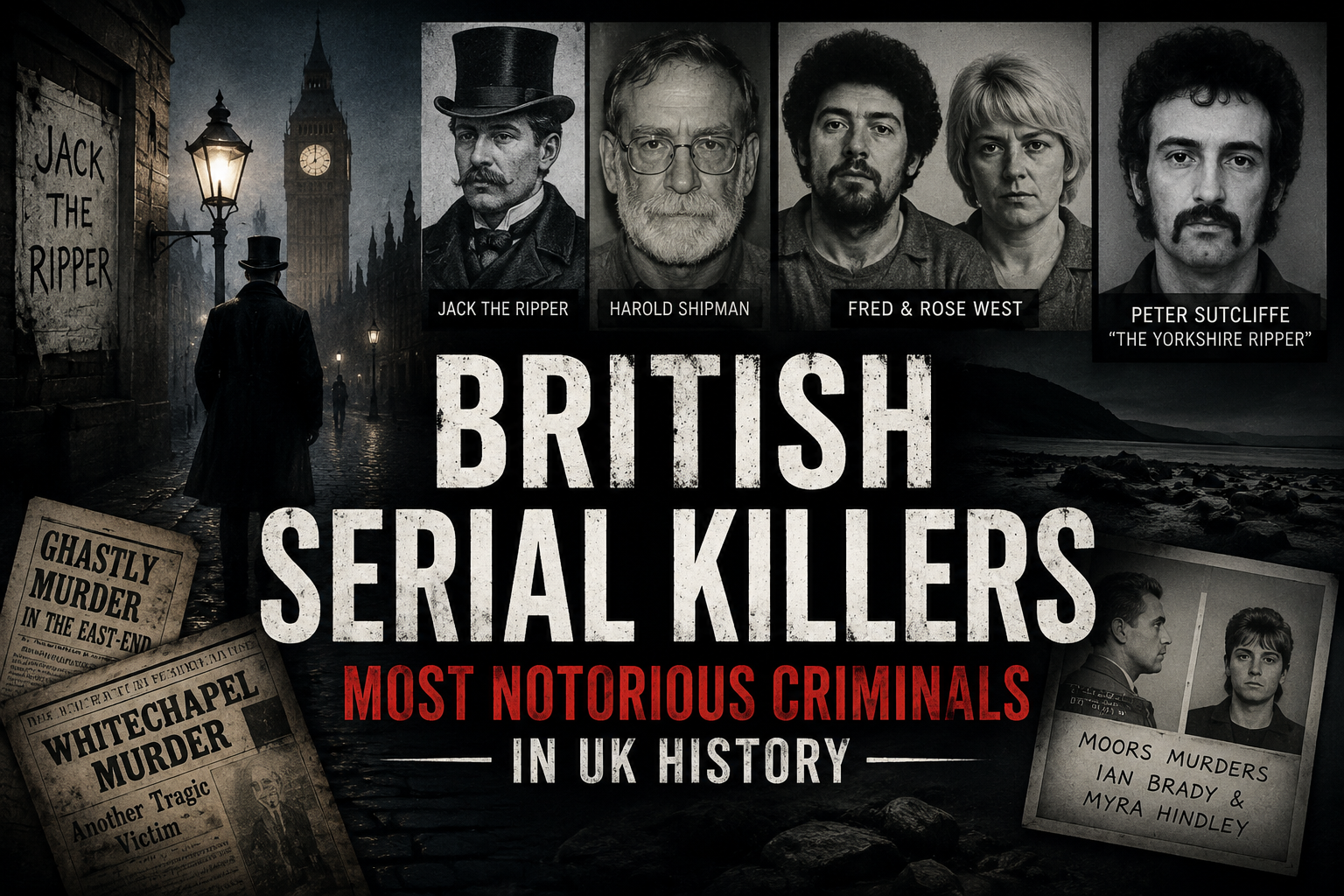
The history of crime in the United Kingdom has been shaped by many disturbing and unforgettable cases, but few subjects capture public attention more than british serial killers. These criminals shocked entire communities, dominated newspaper headlines, and changed the way law enforcement agencies approached criminal investigations. From Victorian London to modern-day Britain, serial killers have left behind stories filled with fear, mystery, and tragedy. Their crimes often exposed weaknesses in policing systems, highlighted social problems, and created nationwide panic that lasted for years.
The fascination with british serial killers continues today through documentaries, books, podcasts, and crime series that analyze their actions and motivations. People remain interested in understanding how ordinary individuals could commit such horrific crimes repeatedly without detection for long periods. While the topic is dark and unsettling, studying these cases also provides insight into criminal psychology, investigative methods, and the evolution of forensic science in the UK.
This article explores the most notorious british serial killers in history, their backgrounds, the impact of their crimes, and how Britain changed its criminal justice system in response to these terrifying events.
The History of Serial Crime in Britain
Britain has experienced violent crime throughout its long history, but the concept of the serial killer became widely recognized during the late nineteenth century. Before advanced policing and forensic methods existed, many murderers escaped detection because communication between police departments was limited and investigative tools were primitive. Criminals could move between towns and cities without leaving behind much evidence, making it easier for repeat offenders to continue their crimes.
The industrial revolution transformed British society in dramatic ways. Rapid urbanization created overcrowded cities filled with poverty, homelessness, and crime. Areas like London’s East End became particularly dangerous, with poor lighting, narrow alleyways, and weak police presence. These conditions created opportunities for violent offenders to operate unnoticed among large populations.
During the twentieth century, the media played a huge role in spreading fear about british serial killers. Newspapers sensationalized murder cases, turning criminals into infamous public figures. Television and radio later amplified this effect, allowing the entire country to follow investigations in real time. Public pressure often forced police departments to modernize investigative strategies and improve cooperation between regions.
Today, criminal profiling, DNA analysis, surveillance systems, and digital databases make it harder for serial offenders to remain undetected. However, the historical cases of british serial killers still serve as important lessons for modern law enforcement agencies and criminologists around the world.
Jack the Ripper and the Terror of Victorian London
No discussion about british serial killers is complete without mentioning the mysterious figure known as Jack the Ripper. Although his true identity has never been officially confirmed, he remains one of the most infamous criminals in history. Operating in London’s Whitechapel district during 1888, Jack the Ripper brutally murdered several women, many of whom were believed to be sex workers living in poverty.
The killings shocked Victorian society because of their extreme violence and gruesome nature. The murderer appeared to possess some knowledge of anatomy, leading investigators and the public to speculate endlessly about his background. Newspapers published graphic details about the crimes, creating widespread panic throughout London.
The inability of police to capture Jack the Ripper exposed serious weaknesses in British policing at the time. Investigators lacked modern forensic tools, fingerprint databases, and organized communication systems. Thousands of letters claiming to be from the killer were sent to police and newspapers, making the investigation even more chaotic.
Despite more than a century of theories and investigations, the identity of Jack the Ripper remains unknown. Historians, criminologists, and amateur detectives continue debating possible suspects, ranging from doctors and butchers to members of the royal family. The mystery surrounding the case has kept public interest alive for generations and helped establish the modern fascination with true crime stories involving british serial killers.
Harold Shipman: The Doctor Who Betrayed Trust
Among all british serial killers, Harold Shipman stands out because of the shocking abuse of trust involved in his crimes. Shipman was a respected general practitioner who murdered his patients over many years while appearing to be a caring and professional doctor. His victims were often elderly individuals, and many deaths initially appeared natural because of his medical position.
Authorities eventually discovered that Shipman had been administering lethal doses of drugs to patients and falsifying medical records to cover up his crimes. Investigators believe he murdered more than 200 people, making him one of the most prolific serial killers in modern history.
The Shipman case caused enormous public outrage because doctors are expected to protect lives, not end them. Families struggled to understand how someone trusted by entire communities could commit such horrifying acts without raising suspicion for so long. The case exposed flaws in Britain’s healthcare oversight systems and led to major reforms in monitoring medical professionals.
After his conviction in 2000, healthcare regulations in the UK became much stricter. New systems were introduced to track unusual death patterns, monitor prescription activity, and review medical practices more carefully. The crimes of Harold Shipman permanently changed the relationship between patients and medical institutions in Britain.
The Moors Murders and National Horror
The Moors Murders remain one of the most disturbing criminal cases involving british serial killers. Ian Brady and Myra Hindley committed a series of murders during the 1960s that horrified the nation because many of the victims were children. The couple lured victims before killing them and burying bodies on Saddleworth Moor in northern England.
Public reaction to the case was intense, particularly because Myra Hindley challenged society’s expectations about female criminals. Her appearance in police photographs became one of the most recognizable images in British criminal history. Newspapers portrayed the pair as symbols of pure evil, and the case deeply affected public perceptions of violent crime.
The investigation into the Moors Murders demonstrated the importance of forensic evidence and persistent detective work. Police eventually uncovered recordings and photographs connected to the crimes, which provided crucial evidence during the trial. However, the emotional damage caused by the murders lasted for decades, especially for the victims’ families.
The case also influenced debates about capital punishment, criminal psychology, and prison sentencing in the UK. Even years later, discussions about Brady and Hindley continued to generate strong public emotions because of the cruelty associated with their crimes.
Peter Sutcliffe and the Yorkshire Ripper Investigation
Peter Sutcliffe, known as the Yorkshire Ripper, terrorized northern England during the late 1970s. He murdered multiple women and attacked several others while evading capture for years. The fear created by his crimes affected everyday life across Yorkshire and surrounding areas, especially for women who felt unsafe walking alone at night.
The investigation into Sutcliffe became one of the largest police operations in British history at the time. Thousands of officers worked on the case, but the investigation faced serious criticism because of poor coordination, investigative mistakes, and misleading evidence. Police focused heavily on assumptions about the killer’s motives, which caused them to overlook important clues.
Media coverage of the Yorkshire Ripper case was relentless. Newspapers and television broadcasts spread updates constantly, creating nationwide anxiety. Women’s rights groups also criticized authorities for advising women to stay indoors rather than focusing entirely on catching the killer.
Sutcliffe was eventually arrested in 1981 after a routine police stop led officers to discover suspicious evidence. His conviction brought relief to the country, but the failures of the investigation prompted major changes in British policing methods and criminal profiling techniques.
Fred and Rose West: Crimes Hidden Behind Ordinary Lives
Fred and Rose West became infamous for crimes that shocked Britain during the 1990s. The couple committed multiple murders over many years while living what appeared to be an ordinary family life in Gloucester. Investigators discovered bodies buried inside and around their home, revealing a horrifying pattern of abuse, torture, and murder.
One reason the case fascinated and disturbed the public was the contrast between the couple’s outward appearance and their secret crimes. Neighbors and acquaintances often described them as unusual but never imagined the extent of the violence occurring behind closed doors.
The investigation uncovered evidence of long-term abuse involving vulnerable young women and even members of their own family. Media attention surrounding the case was enormous, with newspapers publishing extensive details about the discoveries at the West home.
The crimes committed by Fred and Rose West raised important questions about child protection, domestic abuse, and how dangerous individuals can manipulate those around them. Their case remains one of the most disturbing examples in the history of british serial killers.
How Media Coverage Influenced Public Fear
Media coverage has always played a significant role in shaping public perceptions of british serial killers. Sensational headlines, dramatic television reports, and graphic storytelling often intensified fear during major investigations. In some cases, media attention helped police gather information from the public, but it also created panic and misinformation.
During the Jack the Ripper murders, newspapers competed aggressively for readers by publishing shocking stories and speculative theories. In modern cases, television coverage allowed entire communities to follow investigations closely, increasing emotional involvement and national anxiety.
The rise of documentaries, podcasts, and streaming platforms has created a new generation of interest in true crime stories. Many people are fascinated by criminal psychology and investigative procedures, but critics argue that excessive focus on killers can sometimes overshadow the victims and their families.
Social media has further transformed how crime stories spread. Information now travels instantly, allowing rumors and speculation to circulate rapidly during active investigations. While public engagement can occasionally assist law enforcement, it can also complicate cases by spreading false information.
Despite these concerns, public fascination with british serial killers remains extremely strong. True crime content continues attracting large audiences around the world because people seek to understand the motives behind such shocking acts and how investigators eventually solve these crimes.
Psychological Traits Common Among Serial Killers
Criminal psychologists have spent decades studying the behavior and personality traits associated with serial killers. Although every offender is different, researchers have identified several patterns commonly found among violent repeat offenders. Many british serial killers displayed manipulative behavior, lack of empathy, narcissism, and an ability to appear normal in everyday situations.
Some serial killers experienced traumatic childhoods involving abuse, neglect, or violence, though not everyone with difficult backgrounds becomes violent. Mental health disorders, personality disorders, and obsessive fantasies have also been linked to certain offenders. However, experts caution against oversimplifying these cases because human behavior is highly complex.
One disturbing characteristic shared by many serial killers is their ability to gain trust. Harold Shipman used his reputation as a doctor, while Fred and Rose West appeared to live ordinary lives within their community. This ability to blend into society often allows offenders to continue crimes for extended periods.
Modern criminal profiling uses psychological analysis to help investigators identify potential suspects based on behavior patterns. Profilers study crime scenes, victim selection, and offender actions to build psychological profiles that may assist investigations. These methods have become important tools in modern law enforcement, partly because of lessons learned from historical british serial killers.
Advances in British Criminal Investigations
The crimes committed by british serial killers forced major improvements in policing and forensic science throughout the UK. Early investigations relied heavily on witness statements and basic detective work, but modern investigations now involve sophisticated technology and scientific analysis.
DNA testing revolutionized criminal investigations by allowing authorities to identify suspects with remarkable accuracy. Fingerprint databases, surveillance cameras, and digital tracking systems also improved the ability of police to connect crimes across different locations. Communication between regional police departments became far more organized, reducing the likelihood of offenders escaping detection because of poor coordination.
Behavioral profiling and forensic psychology also became important investigative tools. Specialists now assist police by analyzing offender behavior patterns, victimology, and crime scene evidence. These methods help narrow suspect pools and improve investigative strategies.
Public awareness campaigns and missing persons databases have further strengthened investigative capabilities. Today, suspicious patterns can often be identified much faster than in previous decades. While violent crime still exists, advances in technology make it increasingly difficult for serial offenders to avoid detection for long periods.
Why Society Remains Fascinated by British Serial Killers
The continuing interest in british serial killers reflects a broader human fascination with crime, danger, and mystery. Many people are drawn to understanding how individuals can commit acts that seem impossible for ordinary people to imagine. This curiosity drives the popularity of documentaries, books, films, and podcasts focused on criminal cases.
True crime stories often combine suspense, psychology, and investigation, creating narratives that feel both frightening and compelling. Audiences become interested not only in the crimes themselves but also in the detectives, forensic experts, and journalists involved in solving cases.
There is also a psychological element to this fascination. Learning about dangerous criminals can provide a sense of understanding and preparedness, helping people feel more aware of potential threats in society. At the same time, many true crime consumers feel empathy for victims and admiration for investigators who seek justice.
However, ethical concerns remain important. Some critics argue that excessive attention on serial killers can unintentionally glorify criminals while causing pain to victims’ families. Responsible reporting and storytelling should focus on historical lessons, social impact, and the importance of justice rather than sensationalizing violence.
Conclusion
The history of british serial killers is both disturbing and deeply significant in understanding the evolution of crime and justice in the United Kingdom. From the mystery of Jack the Ripper to the horrifying betrayals committed by Harold Shipman and Fred and Rose West, these cases exposed weaknesses in society while forcing major improvements in policing, forensic science, and criminal investigations.
Although the crimes committed by these individuals caused immense suffering, they also led to important changes that strengthened public safety and investigative procedures. Modern Britain now benefits from advanced forensic technology, better police coordination, and greater psychological understanding of violent offenders.
The fascination with british serial killers continues because these cases combine mystery, psychology, fear, and history in ways that deeply affect public imagination. Yet behind every famous case are real victims and families whose lives were forever changed. Remembering their stories remains just as important as understanding the criminals themselves.