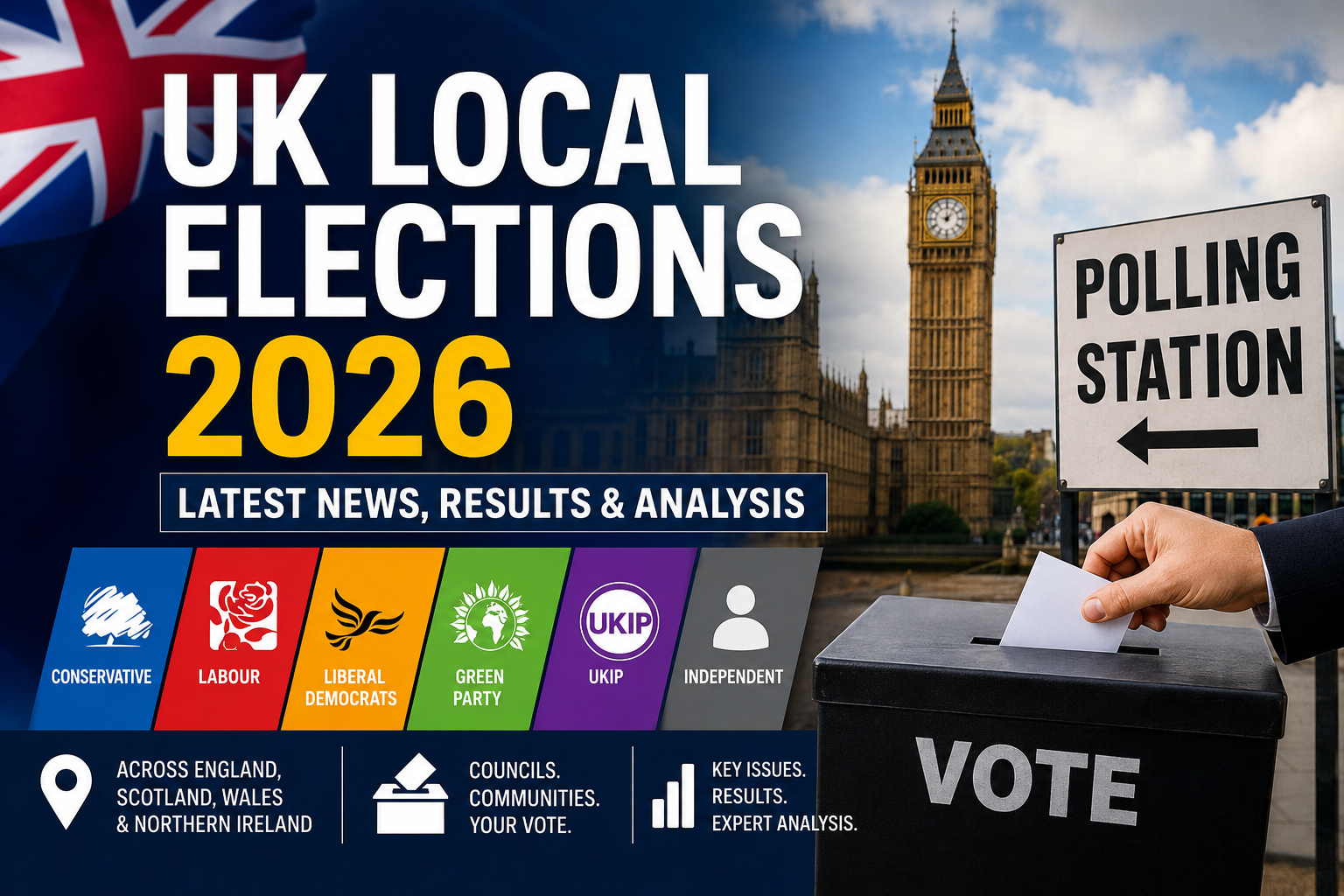
Introduction to the 2026 Local Elections in the United Kingdom
The 2026 local elections in the United Kingdom are shaping up to be one of the most closely watched political events of the year. Across councils, mayoral races, and regional authorities, voters will once again decide who manages essential public services such as housing, education support, waste management, transport, and local planning. Unlike general elections, local elections often reflect more immediate community concerns rather than national ideological battles, yet they frequently become a strong indicator of broader political sentiment.
In the context of the political climate leading into 2026, these elections carry additional weight. Public trust in governance, economic pressures, cost of living challenges, and debates over public services are expected to strongly influence voter behavior. Political analysts are already framing the 2026 contests as a “mid-term referendum” on the governing party’s performance, even though technically they are decentralized local contests.
As campaigns develop, attention is turning toward which parties can mobilize grassroots support effectively and which councils may swing control. While local issues remain central, national narratives inevitably filter into voter decisions, making the 2026 cycle particularly complex and politically significant.
How UK Local Elections Work and Why They Matter
UK Local Elections 2026 operate through a decentralized system where voters elect representatives to local councils responsible for managing day-to-day public services. These councils vary in structure, including metropolitan boroughs, district councils, county councils, and unitary authorities. Each type has slightly different responsibilities, but all play a crucial role in shaping community life.
Voting systems can vary depending on the council type, with most elections using the “first past the post” method. This means the candidate with the most votes wins, even without an absolute majority. In some areas, multi-member wards allow voters to choose multiple candidates, which can lead to more proportional outcomes.
The importance of local elections often goes underestimated. While they may not receive the same attention as national elections, they directly impact essential services such as school funding allocations, local road maintenance, housing approvals, and social care programs. In many cases, local councils also influence environmental policies, urban development projects, and community safety initiatives.
In addition, these elections serve as a political temperature check. Parties use results to assess public approval and adjust strategies accordingly. Strong local performance can build momentum for future national elections, while losses may trigger internal party reforms or leadership pressure.
Key Issues Shaping the 2026 Local Elections UK
Several pressing issues are expected to dominate discussions during the 2026 local elections UK cycle. One of the most influential factors is the cost of living crisis, which continues to affect households across the country. Rising utility bills, housing costs, and inflation concerns have made voters increasingly sensitive to how local councils manage budgets and provide relief.
Another major issue is housing availability. Many urban areas are struggling with shortages of affordable housing, leading to increased pressure on local authorities to approve development projects while balancing environmental and infrastructure concerns. This often creates tension between growth and sustainability.
Public services, especially social care and education, remain at the forefront of voter concerns. Many councils face financial strain, leading to debates about funding priorities and service efficiency. Transport infrastructure, including bus reliability and road maintenance, also continues to be a key local issue in both rural and urban regions.
Environmental policies are gaining traction as well. Local governments are increasingly expected to implement sustainability initiatives, such as waste reduction programs, green transport options, and carbon-neutral planning strategies. These issues resonate strongly with younger voters and urban populations.
Major Political Parties and Their Local Strategies
Political parties across the UK are preparing strategically for the 2026 elections, with each focusing on different strengths and voter bases. The Conservative Party, Labour Party, Liberal Democrats, and regional parties all play significant roles in shaping local governance outcomes.
The Labour Party is expected to focus heavily on urban councils, emphasizing public service improvement, housing development, and investment in social programs. Their strategy often revolves around rebuilding trust in metropolitan areas where they traditionally perform strongly.
The Conservative Party typically maintains strength in suburban and rural councils. Their messaging often focuses on fiscal responsibility, tax management, and efficient local governance. In 2026, they are likely to highlight economic stability and local business support as key campaign themes.
The Liberal Democrats tend to target councils where voter dissatisfaction with the two major parties is high. Their campaigns often emphasize community-led governance, environmental sustainability, and local accountability.
Regional parties and independents also play a crucial role in certain areas, especially in devolved regions. Their influence can significantly shape coalition-building within councils where no single party achieves overall control.
Regional Hotspots and Councils to Watch in 2026
Certain regions are expected to become key battlegrounds in the 2026 local elections UK, with closely contested councils drawing national attention. Urban centers such as London boroughs, Manchester-area councils, Birmingham, and parts of Leeds are likely to see highly competitive races due to diverse populations and shifting political preferences.
In contrast, rural councils in areas such as the South West, East Anglia, and parts of the Midlands often reflect different priorities, including agricultural policy, infrastructure funding, and rural healthcare access. These regions can swing unpredictably depending on local issues and candidate popularity.
Coastal towns and post-industrial regions are also important watchpoints. Many of these areas have experienced economic transitions, and voters often respond strongly to promises of regeneration, job creation, and infrastructure investment.
The results in these key councils often act as indicators of broader national trends. A strong performance in swing regions can signal rising momentum for a party, while losses may highlight dissatisfaction that could carry into future national elections.
Role of Devolution in UK Local Elections
Devolution plays an important role in shaping the political landscape across the United Kingdom. Scotland, Wales, and Northern Ireland each have distinct governance systems that influence how local elections interact with national politics.
In Scotland, local councils operate alongside the Scottish Parliament, with voters often influenced by issues such as independence, healthcare, and education policy. The political dynamics in Scottish councils frequently differ from those in England due to the presence of strong regional parties.
Wales follows a similar structure, where local councils work within the broader framework of the Senedd. Welsh politics often emphasize community services, language preservation, and rural development.
Northern Ireland presents a unique political environment, where local governance is closely tied to historical, cultural, and identity-based politics. Power-sharing arrangements and party alliances often shape local election outcomes differently than in other parts of the UK.
These devolved systems ensure that local elections are not uniform across the country, adding complexity and diversity to the overall political landscape.
Voter Turnout and Engagement Trends in 2026
Voter turnout in local elections has historically been lower than in general elections, and this trend is expected to continue in 2026. However, engagement levels can vary significantly depending on the competitiveness of local races and the prominence of local issues.
One of the ongoing challenges is voter apathy, particularly among younger demographics. Many young voters feel disconnected from local politics, despite being heavily affected by council decisions related to housing, transport, and education.
To address this, political parties and civic organizations are increasing digital engagement efforts. Social media campaigns, community outreach programs, and localized policy messaging are becoming more prominent in encouraging participation.
Postal voting and early voting options are also helping to improve accessibility, making it easier for voters with busy schedules or mobility issues to take part in elections.
Ultimately, turnout in 2026 will likely depend on how strongly voters feel that local councils are impacting their daily lives.
Expected Impact on National Politics
Although local elections are not directly tied to national government formation, their outcomes often influence national political narratives. Strong gains by a party can be interpreted as public approval of its policies, while losses can trigger internal criticism and leadership scrutiny.
For opposition parties, strong local election performance can build momentum and credibility ahead of future general elections. Conversely, ruling parties often face pressure to respond quickly to poor local results, especially in key swing areas.
Media coverage also plays a significant role in shaping perceptions of success or failure. Even small shifts in council control can be portrayed as symbolic victories or setbacks at the national level.
Therefore, the 2026 local elections are not just administrative events—they are politically strategic milestones that can reshape party confidence and direction.
Analysis of Possible Outcomes and Scenarios
Several possible scenarios could emerge from the 2026 local elections UK cycle. One likely outcome is a fragmented political landscape where no single party dominates nationally across councils. This would lead to increased coalition-building and negotiated governance at the local level.
Another scenario involves significant gains by opposition parties in urban areas, signaling dissatisfaction with current national policies. This could create political pressure for policy adjustments or strategic repositioning.
Alternatively, if governing parties perform strongly, it may reinforce their mandate and provide momentum heading into future national contests. However, even strong overall results may be uneven, with regional variations highlighting localized challenges.
Independent candidates and smaller parties could also play a decisive role in closely contested councils, especially where voter frustration with mainstream parties is high.
Overall, the election results are expected to be diverse, reflecting the complex political, economic, and social landscape of the UK.
Conclusion: Why the 2026 Local Elections Matter
The 2026 local elections represent more than just routine council voting—they are a reflection of public sentiment, local governance effectiveness, and broader political direction. From housing and public services to economic pressures and environmental policies, these elections touch nearly every aspect of daily life.
As campaigns intensify and voters evaluate their choices, the outcomes will provide valuable insight into the evolving political mood across the country. While each council result may seem local in isolation, together they form a national picture of trust, priorities, and expectations.
In many ways, the 2026 cycle will serve as both a practical decision-making process for communities and a symbolic moment in the wider political journey of the United Kingdom.